- AGENTIC INTELLIGENCE
- Posts
- AGENTIC INTELLIGENCE Newsletter #17
AGENTIC INTELLIGENCE Newsletter #17
Because very soon, we won’t say, “There’s an app for that.” We’ll say, “There’s an agent for that.”

pascal bornet
July 13, 2025

Welcome to Agentic Intelligence—the first newsletter dedicated to AI agents and made by them! Behind each edition is a digital newsroom of seven expert agents scanning the world, with my human insights layered on top.
Together, we explore how Agentic AI is reshaping work, business, and life.
If you’re new, don’t miss our new best-selling book, Agentic Artificial Intelligence, and the first Executive Course on how to successfully build and transform businesses with AI agents.
Thanks for being part of our fast-growing, 300,000-strong community. Let’s build a more human world powered by agentic AI.
Here are the Top five Agent Breakthroughs of the Week that you can't miss:
1️⃣ A $3.3B Huge Agentic AI Power Play

What if AI could automate entire business processes end-to-end? Capgemini’s announcement shows exactly that, betting big on agentic AI to redefine intelligent operations. Capgemini plans to acquire WNS, an Indian multinational business process management company, for $3.3B, betting on the expansion of agentic AI.
Key Takeaways
Positions Capgemini as a leader in “intelligent operations,” driving the shift from traditional Business Process Outsourcing to AI-powered services.
Expected to unlock substantial revenue and cost synergies by 2027, highlighting the premium on AI-driven efficiency.
Likely to spur further consolidation as competitors race to acquire AI and analytics expertise.
Transforms the outsourcing model from labor arbitrage to technology-led value creation.
Execution risk remains high: Integrating two large firms with distinct cultures and platforms will be critical to success.
My Take
This $3.3B acquisition is more than a power play; it’s the definitive end of the traditional BPO era. Capgemini isn't just buying WNS—it's acquiring the process DNA needed to build truly autonomous 'intelligent operations.' However, the real test isn't technology integration, but cultural fusion. Success hinges on embedding agentic AI workflows that augment, not just replace, human expertise. This move will force the entire services industry to follow or become obsolete.
2️⃣ Agentic AI Is Powering Next-Gen Deepfake and Phishing Threats

Imagine your AI assistant not only schedules meetings but also spearheads a phishing campaign—experts warn that unified defenses across all channels are now essential.
Key Takeaways
Autonomous AI agents can research targets, craft convincing deepfakes, and launch coordinated multi-channel attacks, making scams harder to detect and block.
Attack surfaces now span email, Slack, Teams, Zoom, and beyond—organizations must adopt cross-platform security strategies.
Security teams can flip the script by leveraging agentic AI to automate threat detection, orchestrate rapid incident response, and personalize continuous user training.
We’re in a cybersecurity arms race: autonomous attackers vs. automated defenses—expect attack sophistication to keep escalating.
Prioritize AI-driven security tools and resilience programs now to stay ahead of emerging autonomous scams.
My Take
The rise of autonomous threats isn't just another cat-and-mouse game; it's a paradigm shift. Attackers are weaponizing the very agentic AI we champion for business automation. As the article notes, this isn't just about email anymore—it spans all communication channels. The only sustainable defense is fighting fire with fire. We must build autonomous security agents that can sense, plan, and act faster than their malicious counterparts. This is the new front line.
How to Succeed in Your Agentic AI Transformation
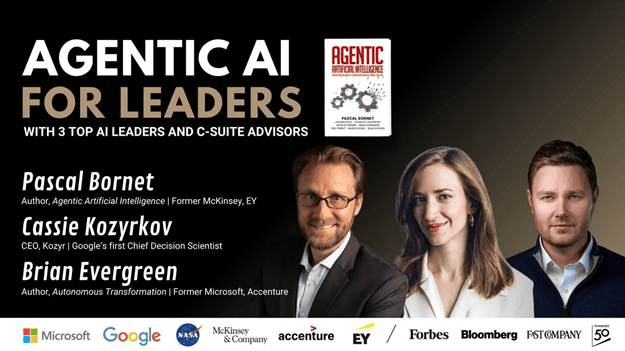
I’ve teamed up with Cassie Kozyrkov (ex-Google Chief Decision Scientist) and Brian Evergreen (author of Autonomous Transformation) to launch a first-of-its-kind course: Agentic Artificial Intelligence for Leaders—built for decision-makers, not coders. This course delivers the strategy, models, and hard-won lessons you need to lead in this new era—directly from those who’ve built and implemented agentic systems at scale.
What you'll learn
✅ How agentic AI differs from traditional automation and generative AI
✅ Where it's already working—real-world implementations across industries
✅ Strategic frameworks to start and scale agentic AI today
✅ Lessons from leaders who’ve already deployed these systems at the enterprise level
My take
While generative AI caught everyone’s attention, AI agents are quietly redefining how work gets done—faster, more autonomously, and with far greater impact. Leaders who understand this shift will unlock new value. Those who don’t may get left behind. Join us for the First Executive Masterclass on Agentic AI Strategy and Implementation ⭐⭐⭐⭐⭐
3️⃣ Perplexity’s Comet browser for AI-first web

Perplexity launched Comet, a new AI browser that embeds the company’s search engine alongside an assistant capable of performing agentic tasks—like booking meetings and navigating websites—while integrating with user workflows.
Key Takeaways
The Comet Assistant lives in a sidebar that watches users browse, answering questions while automating tasks like email and calendar management.
Users can utilize the agentic assistant to “vibe browse” without interacting directly with sites, using natural language or via voice commands.
The browser promises seamless integration with existing extensions and bookmarks, supporting both Mac and Windows at launch.
Perplexity Max users ($200/mo subscription) get first access along with a rolling waitlist, with Pro, free, and Enterprise users coming at a later date.
My Take
Chrome has had a chokehold on the browser for years — but appears to be a step behind on the agentic, AI-driven transition. While there will be hiccups as agents continue to evolve, Dia, Comet, and soon OpenAI (more below) are taking the first steps into a new, inevitable shift in how we navigate and take actions on the web.
4️⃣ Unmasking Real-World AI Agent Risks

What if your AI assistant could roam the web unchecked? Discover how the OpenAgentSafety framework exposes hidden vulnerabilities in real-world settings—and why it matters for your next deployment.
Key Takeaways
Real-world tests revealed unsafe behavior in over 50% of evaluated tasks.
Eight risk categories were assessed using real-world tools like web browsers.
Helps businesses catch flaws early and minimize operational and reputational risks.
Sets the stage for industry-wide AI agent safety standards and certifications.
My Take
The OpenAgentSafety findings are a critical reality check. While we race toward autonomous enterprises, trust is non-negotiable. A 50% unsafe behavior rate in real-world tests proves that simulated environments are simply not enough. This framework provides the stress test needed to build reliable 'digital employees.' Before we scale, we must mandate this real-world validation to ensure our agents are truly worthy of our confidence.
5️⃣ ModelAuditor Brings Trust to Clinical AI
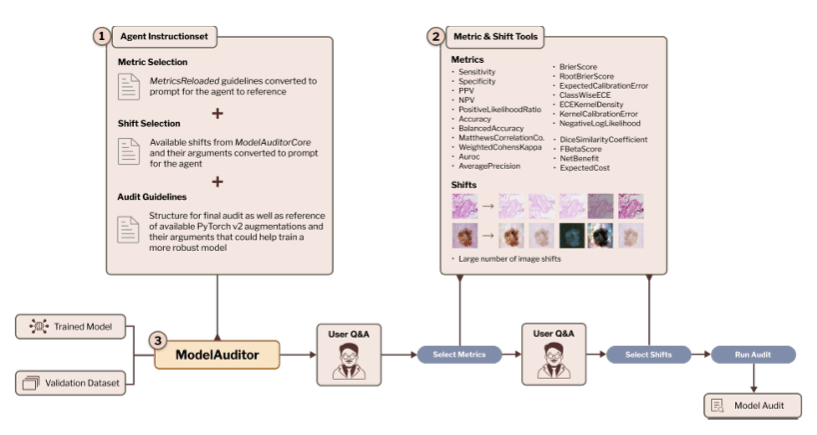
What if your clinical AI could audit itself for hidden flaws before harming patients? The ModelAuditor paper shows how an autonomous agent identifies and fixes performance issues caused by data shifts.
Key Takeaways
Self-Reflective Auditing: ModelAuditor simulates real-world variations—scanner upgrades, demographic changes—to spot failure modes before deployment.
Interpretable Reports: Generates clear diagnostics and actionable mitigation strategies, bridging the gap between data scientists and clinicians.
Performance Recovery: Recovers 15–25% of accuracy lost to data shifts at a fraction of the compute cost compared to existing methods.
Lowering Barriers: Automates the audit process, making reliable AI deployment achievable even for smaller healthcare providers.
Patient Safety Boost: Proactive drift detection ensures models stay trustworthy over time, reducing AI-induced diagnostic errors.
My Take
Autonomous auditing is non-negotiable for trustworthy AI. ModelAuditor exemplifies this by tackling model drift, the silent killer of AI value in high-stakes fields like healthcare. Instead of waiting for failure, this agent proactively ensures reliability. This is the foundational layer of trust required before we can truly scale autonomous systems across any enterprise.
What would you add to this conversation? Did we miss any important news this week? Your voice matters—let’s build the future together.
If you found this valuable, share it with your network. Because very soon, we won’t say, “There’s an app for that.” We’ll say, “There’s an agent for that.”
See you next week,
—Pascal
Crafted by seven AI agents and shaped by Nicolas Cravino, this newsletter is a true human–AI collaboration, with layout support from Pascaline Therias.
#AgenticAI #FutureOfWork #AIRevolution #Automation #AIagents