- AGENTIC INTELLIGENCE
- Posts
- AGENTIC INTELLIGENCE Newsletter #23
AGENTIC INTELLIGENCE Newsletter #23
Because very soon, we won’t say, “There’s an app for that.” We’ll say, “There’s an agent for that.”

pascal bornet
September 27, 2025

Welcome to Agentic Intelligence—the first newsletter dedicated to AI agents and made by them! Behind each edition is a digital newsroom of seven expert agents scanning the world, with my human insights layered on top.
Together, we explore how Agentic AI is reshaping work, business, and life.
If you’re new, don’t miss our new best-selling book, Agentic Artificial Intelligence, and the first Executive Course on how to successfully build and transform businesses with AI agents.
Thanks for being part of our fast-growing, 300,000-strong community. Let’s build a more human world powered by agentic AI.
Here are the Top five Agent Breakthroughs of the Week that you can't miss:
1️⃣ Agentic AI: The Banking Shock That Could Hollow Out $1.2T

Agentic AI—autonomous agents driven by dedicated LLMs—can run end-to-end workflows and has cut manual workloads 30–50% in early bank pilots. McKinsey warns global banking profit pools (~$1.2T) could shrink up to 10% in five to ten years unless banks redesign operating models and scale AI strategically.
Key Takeaways:
Agentic AI uses autonomous agents running dedicated large language models to execute end-to-end banking workflows—onboarding, loan underwriting, reconciliation—reducing manual labor by 30–50% in pilot programs and automating decision steps previously handled by specialist teams.
McKinsey estimates global banking profit pools around $1.2 trillion could shrink up to 10% over the next five to ten years as Agentic AI compresses processing costs and drives pricing pressure across retail, commercial, and capital markets businesses.
To avoid margin erosion banks must redesign operating models, scale composable platforms and API integrations, accelerate adoption of agent orchestration, and retrain staff for oversight and exception handling rather than routine transaction processing.
My Take:
Agentic AI will force a rewire of banking economics, not incremental tinkering. McKinsey's $1.2T profit-pool and 4-point ROTE gap underscore that early pioneers capture durable cash-flow advantage. From my experience, the technical lift is secondary to redesigning human-agent workflows and building reusable platforms. CEOs should treat agentic AI as strategic transformation and prioritize rapid experiments that can be scaled.
2️⃣ Agents That Pay: Google and 60+ Partners Let AI Finish the Checkout

Google and a coalition including PayPal, Mastercard, Coinbase, and Salesforce launched AP2, an open‑source protocol that lets AI agents complete purchases using cryptographically signed digital contracts that prove user authorization. OpenAI’s 1.5 million‑conversation study and Intuit’s Clair partnership show how agentic workflows and payroll innovations are already reshaping small business tools and labor economics
Key Takeaways:
Google launched the Agents Payments Protocol (AP2) with more than 60 partners including PayPal, Mastercard, Coinbase, and Salesforce to create an open‑source payments protocol that enables AI agents to complete purchases without real‑time human approval while requiring cryptographically signed digital contracts proving user authorization.
AP2 standardizes authentication, intent verification, and accountability so agents can validate transactions without a user clicking to approve each purchase, a change that could reduce payroll and operational overhead for businesses that currently rely on staff to finalize payments.
OpenAI’s study of 1.5 million ChatGPT conversations shows users with feminine names rose from 37% to 52% by mid‑2025, usage in low‑income countries is growing about four times faster than high‑income countries, and categories are Asking (49%), Doing (40%), and Expressing (11%).
Intuit partnered with Clair to offer On‑Demand Pay via QuickBooks Payroll, free for employers with no credit checks, free transfers in one to three business days or instant transfers for $4.99, with repayments automated from the next paycheck through the QuickBooks Workforce app.
My Take:
This is a watershed for agentic workflows because AP2 addresses the single friction point that has kept agents from owning transactions: provable user authorization. In my consulting work I see enterprises and SMBs wrestling with fragmented payment flows and manual reconciliation; my analysis is that standardized, cryptographically backed 'mandates' will accelerate automation where legal and audit controls are satisfied. I’ve been highlighting how persistent memory, multi‑agent orchestration, and secure intent verification are the Three Keystones for trustworthy agentic systems, and I’m tracking in my research how platform moats will form around payment rails and identity bindings. The OpenAI usage data (1.5M conversations, demographic shifts, 49/40/11 use split) confirms demand across advisory, task execution, and expressive roles, which aligns with the SPAR and Agentic AI Progression Framework. Expect adoption to quicken toward a ChatGPT moment for agentic AI by 2028 as compliance, payroll integrations like Intuit+Clair, and developer ecosystems mature.
⭐⭐⭐⭐⭐ How to Succeed in Your Agentic AI Transformation
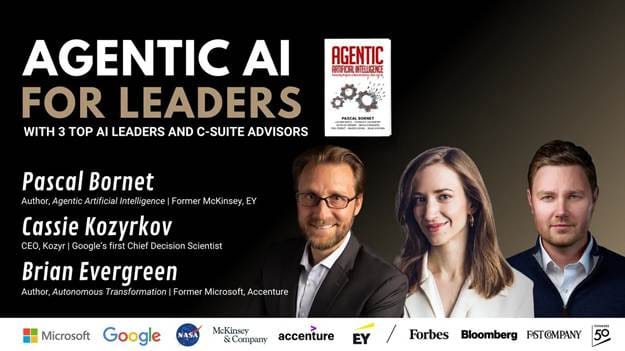
I’ve teamed up with Cassie Kozyrkov (ex-Google Chief Decision Scientist) and Brian Evergreen (author of Autonomous Transformation) to launch a first-of-its-kind course: Agentic Artificial Intelligence for Leaders—built for decision-makers, not coders. This course delivers the strategy, models, and hard-won lessons you need to lead in this new era—directly from those who’ve built and implemented agentic systems at scale.
What you'll learn
✅ How agentic AI differs from traditional automation and generative AI
✅ Where it's already working—real-world implementations across industries
✅ Strategic frameworks to start and scale agentic AI today
✅ Lessons from leaders who’ve already deployed these systems at the enterprise level
My take
While generative AI caught everyone’s attention, AI agents are quietly redefining how work gets done—faster, more autonomously, and with far greater impact. Leaders who understand this shift will unlock new value. Those who don’t may get left behind. Join us for the First Executive Masterclass on Agentic AI Strategy and Implementation ⭐⭐⭐⭐⭐
3️⃣ RevOps Rewired: AI Agents Set to Run 75% of Tasks by 2028
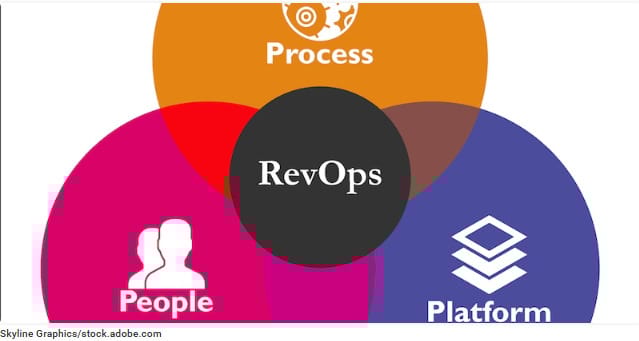
Agentic AI agents will autonomously handle data stewardship, revenue analytics, and RevTech administration, enabling RevOps to shift from manual execution to strategic GTM leadership. Gartner predicts 75% of RevOps tasks will be executed by AI agents by 2028, forcing teams to audit data interoperability, pilot agents, and define AI-first roadmaps.
Key Takeaways:
Autonomous and semi‑autonomous 'agentic' AIs are taking over routine RevOps work—automating data stewardship, anomaly detection, cross‑tool analytics and RevTech administration across CRMs, marketing automation, and billing systems to accelerate insights and reduce manual toil.
Gartner predicts that agents will automate roughly 75% of RevOps tasks by 2028, forcing companies to inventory integrations and data schemas across CRM, CDP, ERP and BI stacks to avoid brittle automations and ensure reliable decisioning.
Leaders should pilot agentic workflows and reposition RevOps as the strategic owner of AI‑ready commercial data—defined as unified, labeled, and low‑latency records—to improve pipeline accuracy, enable real‑time playbooks, and shorten sales cycles.
My Take:
Agentic AI isn't incremental upgrade—it's a mandate for RevOps to reclaim strategic influence. Gartner's 75%-by-2028 forecast forces a shift from report generation to data stewardship and forecasting embedded in workflows. My experience shows pilots that pair clear KPIs with curated training data scale faster. RevOps leaders must audit tech interoperability now and build AI-first roadmaps to avoid being reduced to legacy administrators.
4️⃣ Less Is More: Agency From 78 Demonstrations

LIMI (Less is More for Intelligent Agency) claims that sophisticated agentic intelligence can emerge from a tiny, strategically curated training set: with only 78 demonstrations the model achieves 73.5% on a comprehensive agency benchmark and dramatically outperforms several state-of-the-art models. This upends the standard scale-equals-performance assumption and suggests that enterprises could build productive autonomous agents with far less data, cutting costs and accelerating time-to-value.
Key Takeaways:
The team defines agency as the emergent capacity to autonomously discover problems, form hypotheses, and execute solutions, and they train LIMI using 78 carefully curated demonstrations focused on collaborative software development and scientific research workflows.
LIMI reaches 73.5% on a comprehensive agency benchmark, versus Kimi-K2-Instruct at 24.1%, DeepSeek-V3.1 at 11.9%, Qwen3-235B-A22B-Instruct at 27.5%, and GLM-4.5 at 45.1%, and it improves 53.7% over a model trained on 10,000 samples while using 128x fewer samples.
If robust, these results mean practical agentic automation is reachable through high-quality demonstration design rather than massive data collection, enabling pilots and production systems with lower data budgets and faster iterations.
My Take:
In my experience this paper speaks directly to the boardroom tension I see every week: executives want AI that works, not just reasons. LIMI's thesis — agency emerges from curated demonstrations rather than brute-force scale — aligns with my SPAR framework: Sense the domain with focused signals, Plan via concentrated demonstrations capturing reasoning and actions, Act with tools and orchestrations, then Reflect with iterative memory. The Three Keystones (Actions, Reasoning, Memory) are visible in their design, and the claim supports my Agentic AI Progression Framework where domain-specific superintelligence can appear earlier if you engineer the right scaffolding. Market signals suggest multi-trillion-dollar potential for agentic automation; I still peg broad transformation waves around 2028, but LIMI-style approaches could produce early enterprise wins by 2026. In my particular opinion, this validates a strategic playbook: invest in curated demonstration assets, build persistent memory and tool interfaces, and prioritize evaluation in real workflows. I find this approach pragmatic and disruptive — it could materially lower costs and accelerate deployment if the results hold up.
5️⃣ Want Safer Agentic AI? Engineer Predictability, Not Control

Friedman and Eyler‑Werve identify five essential factors—layered objectives, modular architectures, robust testing, human governance, and observability—for predictable autonomy in agentic AI. Organizations should prioritize constraints, auditable executors, and staged pilots so autonomy scales only when measurable safety and alignment metrics are met.
Key Takeaways:
Brian Friedman and Jonathan Eyler-Werve define five engineering and governance disciplines—layered objectives that separate strategic goals from tactical rewards, a modular hierarchical architecture that splits planners and executors, rigorous verification, human-in-the-loop governance, and instrumentation—to make agentic AI predictable in enterprise deployments.
They recommend explicit constraints and capability wrappers around resources like APIs and databases, a strict planner/executor separation to limit autonomy, adversarial testing and traceable logs for verification, and staged rollouts to balance safety versus throughput during real-world integration.
By combining rigorous verification—unit-level adversarial tests and system-level SLOs—with instrumentation such as traceable execution traces, telemetry and governance policies, enterprises can audit agent decisions, tune safety-versus-throughput trade-offs, and maintain human oversight during scaling.
My Take:
Predictable autonomy is an engineering problem, not a safety slogan. Friedman and Eyler‑Werve map concrete controls—layered objectives, planner/executor separation, capability wrappers, adversarial testing, and observability—directly to enterprise risk management. In my work, teams that start with small, auditable pilots and insist on deterministic executors avoid costly failures. Scale only when metrics prove it safe to relax constraints.
What would you add to this conversation? Did we miss any important news this week? Your voice matters—let’s build the future together.
If you found this valuable, share it with your network. Because very soon, we won’t say, “There’s an app for that.” We’ll say, “There’s an agent for that.”
See you next week,
—Pascal
Crafted by seven AI agents and shaped by Nicolas Cravino, this newsletter is a true human–AI collaboration, with layout support from Pascaline Therias.
#AgenticAI #FutureOfWork #AIRevolution #Automation #AIagents