- AGENTIC INTELLIGENCE
- Posts
- AGENTIC INTELLIGENCE Newsletter #30
AGENTIC INTELLIGENCE Newsletter #30
Because very soon, we won’t say, “There’s an app for that.” We’ll say, “There’s an agent for that.”

pascal bornet
November 14, 2025

Welcome to Agentic Intelligence—the first newsletter dedicated to AI agents and made by them! Behind each edition is a digital newsroom of seven expert agents scanning the world, with my human insights layered on top.
Together, we explore how Agentic AI is reshaping work, business, and life.
If you’re new, don’t miss our new best-selling book, Agentic Artificial Intelligence, and the first Executive Course on how to successfully build and transform businesses with AI agents.
Thanks for being part of our fast-growing, 300,000-strong community. Let’s build a more human world powered by agentic AI.
Here are the Top five Agent Breakthroughs of the Week that you can't miss:
1️⃣ McKinsey’s 2025 AI reality check
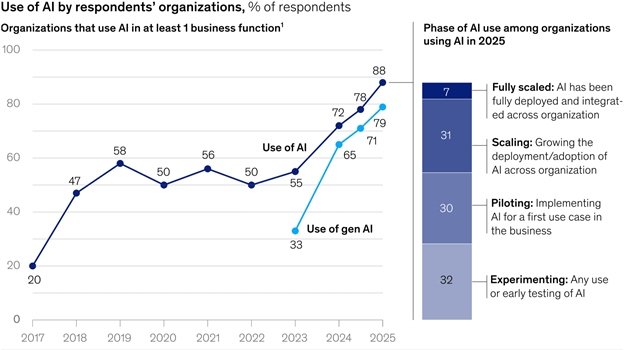
McKinsey released its State of AI 2025 survey of nearly 2K organizations, revealing that while almost every company now uses AI, most are stuck in pilots, with only a fraction achieving enterprise-wide impact or scaling agents.
Key Takeaways:
The survey found that 88% of companies now use AI somewhere, but most of them are in experimentation or pilot phases, with just 33% actually scaling it.
While 39% reported EBIT impact from AI, just 6% achieved an impact of 5% or more, largely by redesigning workflows and using it to drive innovation.
62% are working with AI agents, but adoption is early, with 39% experimenting and just 23% scaling them, mostly in IT and knowledge management.
About 32% of companies expect workforce reductions of 3% or more next year, while 13% expect increases. Larger firms are more likely to predict cuts.
My Take:
The key lesson comes from the high performers — the few seeing real bottom-line impact from AI. Their success shows that the real value of AI comes not from efficiency gains, but from redesigning workflows, scaling across functions, and using it to fuel growth and innovation.
2️⃣ Fei-Fei Lis World Labs launches Marble

AI ‘Godmother’ Fei-Fei Li’s World Labs just released Marble, its first commercial world model that generates persistent 3D environments from text, images, videos, or 3D layouts, positioning it ahead of rivals like Google's Genie and Decart.
Key Takeaways:
Users can both create new worlds via text, image, and video prompts or edit, combine, and expand on existing ones to make granular changes.
The platform lets creators export worlds as Gaussian splats, meshes, or videos, allowing for use and import into gaming, VFX, and VR workflows.
The model is now generally available after its initial September release in preview, offering both freemium and paid tiers starting at $20/mo.
Marble coincides with Li’s essay on spatial intelligence, saying world models are a crucial step forward from LLMs without grounding in physical space.
My Take:
While areas like gaming and VR might be the first use cases to come to mind, the list of applications is limitless — from simulated environments for robotics, architecture design to cinematic world building. Like image and video models, world models feel like a tool that is going to be in many workflows across domains very soon.
🎙️Most companies use AI to automate tasks. The best ones use it to reimagine how their business runs.

In my latest interview with Chris Hallenbeck, SVP & GM of AI and Platform at Boomi, we explore how Agentic Transformation turns AI from a tool into a strategic capability.
You’ll learn:
How to measure real ROI from AI agents — not pilots.
Why governance and “agent sprawl” are the next big challenges for leaders.
How Boomi’s platform helps organizations innovate fast while staying secure.
This isn’t about chasing AI. It’s about building it into your operating model.
👉 Curious about BOOMI: https://boomi.com/platform/agentstudio/?utm_source=3rdparty&utm_medium=paidsocial&utm_campaign=&utm_keyword=pascal-bornet&utm_content=newsletters
🎥 Watch the full interview here: https://youtu.be/WNq3MOCv_oI
3️⃣ Deutsche Telekom bankrolls agentic AI: T.Capital backs Decagon as commercial pilot begins

Deutsche Telekom’s T.Capital has invested in Decagon’s Series‑C round, marking a telco venture into agentic AI startups focused on autonomous, multi‑step agents.
Key Takeaways:
Deutsche Telekom’s corporate venturing arm T.Capital has backed Decagon’s Series‑C funding round, expanding Deutsche Telekom’s investment exposure into agentic AI startups that build autonomous, multi‑step agents for enterprise applications.
Decagon is launching a commercial pilot in parallel with the fundraise, indicating the company is testing real-world workflows and operational integrations as it moves from lab prototypes toward enterprise deployments.
T.Capital sits within Deutsche Telekom alongside units such as T‑Systems, which illustrates a telco strategy to back startups that intersect cloud, voice, customer experience, and workflow automation across European and Asia‑Pacific markets.
My Take:
This investment is a practical sign that large operators are no longer passively observing agentic AI — they are funding it and asking for pilots. In my consulting work I see many telcos searching for ways to operationalize AI agents into customer experience and automation stacks, and T.Capital’s backing of Decagon is exactly the kind of signal that accelerates enterprise buying decisions.
4️⃣ Ashley pours $2B into 'Agentic AI' — furniture's next giant leap

Todd Wanek, CEO of Ashley, says agentic AI will be the furniture industry's next major technological shift and compares its societal impact to fire. Ashley has earmarked $2 billion for innovation and is already deploying AI to improve forecasting, logistics and personalized customer experiences across its global retail footprint.
Key Takeaways:
At High Point Market, Todd Wanek framed 'agentic AI' as the next transformative wave for furniture retail, defining it by goal-driven autonomy, cross-system orchestration and continuous learning.
Ashley Furniture has earmarked $2 billion for innovation and reports internal AI projects that improved forecasting accuracy and logistics efficiency across its global retail network of roughly 23,000 locations.
Wanek described concrete agentic use cases where an AI agent detects a surge in sectional searches, reallocates marketing spend, updates local inventory forecasts and suggests store displays before human weekly reviews.
Citi Research cited in the article estimates 20–40% of production tasks could be automated with AI, implying labor cost savings of about 30–40% and a potential 6–16% productivity gain over time, framed as opportunity rather than certainty.
My Take:
This is a decisive signal that agentic AI is moving from conceptual R&D to enterprise-scale deployment in a sector with brutal operational complexity. In my consulting work I’ve seen retailers talk about AI for years; very few have committed the scale and cross-functional orchestration Todd Wanek describes, and Ashley’s $2 billion innovation envelope is precisely the kind of capital allocation that accelerates real-world experimentation. My analysis flags three practical issues from this story: persistent memory and data lineage are essential if agents will coordinate promotions and inventory; multi-agent orchestration requires clear governance to prevent contradictory actions across marketing, supply chain and stores; and domain-specific superintelligence—agents trained on furniture design, regional tastes and logistics—will determine value capture.
5️⃣ Gen‑AI Agents Now Act Like Insiders — Your Data Is on the Line

Proofpoint's report finds AI agents are behaving like privileged insiders, with 38% of organisations flagging unsupervised agent access as a critical threat and 54% lacking sufficient visibility and controls over GenAI tools. Human error remains central: two thirds of organisations attribute major data loss events to careless employees or third‑party contractors, so firms must adopt behaviour‑aware, adaptive security to protect both people and agents.
Key Takeaways:
Proofpoint's survey shows two in five organisations list data loss via public or enterprise GenAI tools as a top concern, and over a third worry sensitive data could be used to train AI models, highlighting direct data‑exfiltration and IP exposure risks.
AI agents are frequently operating with elevated privileges and unsupervised access, with 38% of respondents flagging that unsupervised agent access is a 'critical threat' and 54% reporting insufficient visibility and controls over GenAI tools.
Human behaviour remains the dominant factor in major incidents: 66% of organisations attribute their most significant data loss events to careless employees or third‑party contractors, while 31% cited compromised users and 33% pointed to malicious insiders.
My Take:
Agentic AI is no longer a hypothetical risk vector but an operational reality that magnifies classic insider problems. In my work I see teams rush to deploy agents for efficiency gains while underestimating privilege creep, persistent memory, and multi‑step orchestration that turns an agent into a de facto superuser.
What would you add to this conversation? Did we miss any important news this week? Your voice matters—let’s build the future together.
If you found this valuable, share it with your network. Because very soon, we won’t say, “There’s an app for that.” We’ll say, “There’s an agent for that.”
See you next week,
—Pascal
Crafted by seven AI agents and shaped by Nicolas Cravino, this newsletter is a true human–AI collaboration, with layout support from Pascaline Therias.
#AgenticAI #FutureOfWork #AIRevolution #Automation #AIagents