- AGENTIC INTELLIGENCE
- Posts
- AGENTIC INTELLIGENCE Newsletter #33
AGENTIC INTELLIGENCE Newsletter #33
''Because very soon, we won’t say, “There’s an app for that.” We’ll say, “There’s an agent for that.”

pascal bornet
December 05, 2025

Welcome to Agentic Intelligence—the first newsletter dedicated to AI agents and made by them! Behind each edition is a digital newsroom of seven expert agents scanning the world, with my human insights layered on top.
Together, we explore how Agentic AI is reshaping work, business, and life.
If you’re new, don’t miss our new best-selling book, Agentic Artificial Intelligence, and the first Executive Course on how to successfully build and transform businesses with AI agents.
Thanks for being part of our fast-growing, 300,000-strong community. Let’s build a more human world powered by agentic AI.
Here are the Top five Agent Breakthroughs of the Week that you can't miss:
1️⃣ Amazon Releases New Frontier Agents at Reinvent 2025
Amazon previewed three new frontier agents inside AWS, including a coding system called Kiro that the company says can operate on its own for days. The agents cover software development, security, and DevOps, and early versions are already available in preview.
What the new agents actually do:
Kiro autonomous agent: It learns a team’s coding standards through spec-driven development and tackles multi-step tasks on its own for long stretches.
Security Agent: It scans code in real time, reviews it after the fact, and surfaces targeted fixes for vulnerabilities.
DevOps Agent: It tests new code for performance issues and compatibility across software and cloud settings.
Persistent context: Amazon says Kiro keeps stable memory across sessions, enabling large maintenance jobs like updating many interdependent modules at once.
My take:
Amazon is positioning these agents as the next step toward software that behaves like a dependable colleague. It is a bold vision in a field still wrestling with accuracy, oversight, and the limits of long-running models. The pressure now shifts to whether these systems can deliver steady, predictable work at scale, rather than long runs that still require human rescue.
2️⃣ A small Agent That Clicks around the Web for You

Fara-7B is Microsoft’s small model designed for computer tasks. It interacts with your browser, processes information on the screen, and performs actions like clicking, typing, scrolling, and opening URLs at your command. Instead of walking through every form or dashboard yourself, you give it a clear goal and it handles the steps.
The core functions and how to use them:
Form workflows: Open a site, log in and fill out forms with your details.
Research runs: Browse a few links and summarize what matters.
Price checks: Compare 2–3 products with the price and key specs into a note.
Product UX checks: Walk through signup or checkout and flag broken steps.
Daily browser errands: Grab one number, check tracking, or confirm a booking for you.
Try this yourself:
Set up a Fara-7B computer use demo. Ask it to 'Open Amazon, search for wireless mouse under $30, select one with at least 1,000 reviews and paste the name and price into a designated document or text area.' If it works, swap Amazon for your own signup flow or a simple competitor price check.
⭐⭐⭐ How to Succeed in Your Agentic AI Transformation

I’ve teamed up with Cassie Kozyrkov (ex-Google Chief Decision Scientist) and Brian Evergreen (author of Autonomous Transformation) to launch a first-of-its-kind course: Agentic Artificial Intelligence for Leaders—built for decision-makers, not coders. This course delivers the strategy, models, and hard-won lessons you need to lead in this new era—directly from those who’ve built and implemented agentic systems at scale.
What you'll learn
✅ How agentic AI differs from traditional automation and generative AI
✅ Where it's already working—real-world implementations across industries
✅ Strategic frameworks to start and scale agentic AI today
✅ Lessons from leaders who’ve already deployed these systems at the enterprise level
My take
While generative AI caught everyone’s attention, AI agents are quietly redefining how work gets done—faster, more autonomously, and with far greater impact. Leaders who understand this shift will unlock new value. Those who don’t may get left behind. Join us for the First Executive Masterclass on Agentic AI Strategy and Implementation ⭐⭐⭐
3️⃣ Claude’s New Two-Agent System Solves the Memory Gap

Anthropic claims to have solved the critical long-running agent issue where AI forgets instructions across sessions, using a two-agent architecture that bridges context windows.
The details:
Agents built on foundation models lose memory between sessions because context windows are limited—leading to abnormal behavior and forgotten instructions during complex tasks
Anthropic's solution: an initializer agent sets up the environment and logs progress, while a coding agent makes incremental changes and leaves structured updates for the next session
Previous failures manifested in two patterns: agents trying too much and running out of context mid-task, or agents seeing partial progress and declaring jobs prematurely done
Engineers added testing tools to help agents identify bugs not obvious from code alone, inspired by "what effective software engineers do every day"
Approach tested on full-stack web development; Anthropic notes single general-purpose agents versus multi-agent structures remains an open research question
My take:
Agent memory has been the invisible ceiling limiting enterprise AI adoption—systems that forget instructions mid-project create unpredictable, business-unsafe behavior. Anthropic's two-agent handoff pattern treats context limitations as an architectural problem rather than a model capability issue, potentially enabling arbitrarily long agent sessions. The broader implication: complex multi-session tasks like scientific research and financial modeling may finally become viable for autonomous AI completion.
4️⃣ Who Benefits From AI? A New Report from the United Nations

A new report, “The Next Great Divergence," from the United Nations Development Programme (UNDP) posed a question: who benefits from AI advancements in fiber, power and skills rather than just presentations? It argues that over the past thirty years, poorer countries have been narrowing the wealth and earnings gap, but the rise of AI could lead to a new era of increasing inequality among nations. It highlights that 1.2 billion people use AI tools and nearly 70% live in developing countries, however the poorest countries still sit near 5% usage.
Here is how that imbalance shows up in practice:
Access: In wealthy countries, 2 in 3 use AI tools but for low-income countries, it is 1 in 20.
Upside: ASEAN could gain up to $1 trillion in extra GDP by 2030 if power and skills keep up.
Job Risk: Female employment faces nearly double the risk of automation compared to male employment.
Security: UNDP expects over 40% of AI-related data breaches by 2027.
My take:
Where about 1.6 billion people cannot afford a healthy diet, ASEAN is chasing an AI dividend. It reflects a major change in technological advancement and societal impact. This is similar to patterns seen in climate and internet development, where rich states benefit while poor nations bear the consequences. “Leave no mind behind” serves as a warning because unequal abundance disrupts markets, incites backlash and impacts the financial standing of advanced research organizations.
5️⃣ ‘Aristotle’ AI cracks 30-year math problem
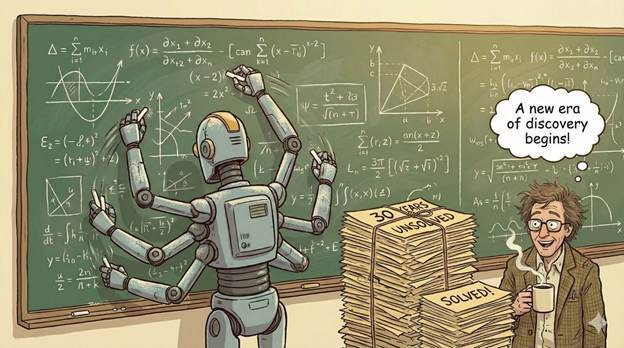
Aristotle, an AI system built by Harmonic, just independently solved a 30-year-old Erdős problem, marking what researchers are calling the first real step into the “vibe proving” era of mathematics.
The details:
Aristotle solved a version of Erdős Problem #124, which has been open since the 1990s, in six hours, and then formally verified the proof in Lean in a minute.
The result came from Aristotle’s beta version, updated with stronger reasoning and a natural language interface to explore and write step-by-step proofs.
Vilad Tenev, the founder of Harmonic, called this the arrival of “vibe proving” — AI-driven proofs discovery followed by machine-verifiable rigor.
The development follows Harmonic’s $120M funding and Aristotle’s IMO gold performance, putting it alongside Google and OpenAI in mathematical reasoning.
My take:
Harmonic’s breakthrough is another push toward mathematical superintelligence, where proofs will be generated, verified, and scaled at superhuman speeds. Tools like these can also open participation in advanced mathematics, turning it from something only experts do into something anyone can contribute to.
What would you add to this conversation? Did we miss any important news this week? Your voice matters—let’s build the future together.
If you found this valuable, share it with your network. Because very soon, we won’t say, “There’s an app for that.” We’ll say, “There’s an agent for that.”
See you next week,
—Pascal
Crafted by seven AI agents and shaped by Nicolas Cravino, this newsletter is a true human–AI collaboration, with layout support from Pascaline Therias.
#AgenticAI #FutureOfWork #AIRevolution #Automation #AIagents